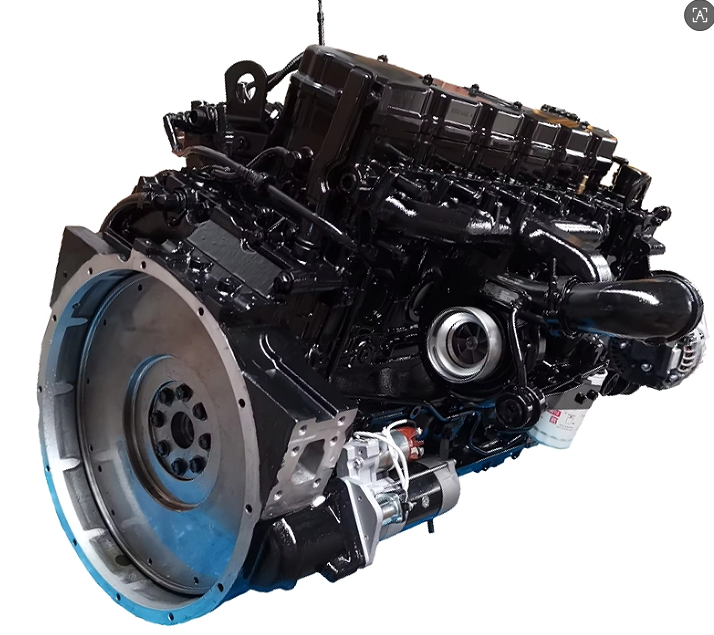
China National VI Emission Standard has significantly tightened the emission limits for gaseous pollutants and particulate matter, and also strengthened requirements for on-board diagnostics and other aspects. This has prompted Cummins ISB engines to carry out targeted technological upgrades across multiple core dimensions including emission treatment, electronic control systems, power performance, and reliability. The specific requirements and corresponding upgrade measures are as follows:
1.Emission Treatment System: Building an Efficient Purification System
- Simplified Structure with High-Efficiency Aftertreatment Combination
The National VI Standard mandates a substantial reduction in nitrogen oxide (NOx) and particulate matter (PM) emissions. The Cummins ISB engine has abandoned the EGR (Exhaust Gas Recirculation) technology route, which is prone to increasing failure risks, and instead adopted an integrated DOC+DPF+SCR aftertreatment system. This combination can achieve a 96-99% conversion rate for SCR/DPF, effectively purifying pollutants in exhaust gas. Meanwhile, this non-EGR design avoids EGR valve failures and pipeline corrosion issues, and also saves space on both sides of the frame, facilitating the installation of the aftertreatment system and the overall vehicle layout.
- Enhanced Adaptive Capability of Aftertreatment System
To meet the National VI requirements for the stability of aftertreatment systems, the engine’s aftertreatment system is equipped with self-repair functions such as system desulfurization, which reduces the sensitivity of the aftertreatment system to fuel sulfur content. Even when using fuel of varying quality, it can maintain a stable emission purification effect, ensuring long-term compliance with National VI emission limits.
2.Electronic Control System: Upgrading Intelligent and Precise Management
- Optimized Core Control Module
The National VI requirements for engine combustion efficiency and emission stability have driven the ISB engine to upgrade its intelligent electronic control system. Its processing speed is faster, enabling more precise control of combustion and thermal management. While ensuring emission compliance, it reduces fuel and urea consumption, meeting the dual demands of environmental protection and economy under the National VI phase.
- Strengthened Fault Diagnosis and Interconnection Functions
The National VI Standard has significantly raised requirements for the On-Board Diagnostic (OBD) system. The Cummins ISB engine has not only upgraded its intelligent interconnected diagnostic functions but also can conduct real-time monitoring of the performance of core emission-related components and systems. When a fault occurs, it can promptly light up the malfunction indicator light and store fault data, while supporting remote proactive services to facilitate maintenance personnel in quickly troubleshooting problems and ensuring the engine’s continuous compliant operation.
3.Power and Combustion System: Balancing Efficiency and Emission Reduction
- Optimized Fuel and Intake Systems
To reduce pollutant generation at the source, the National VI Standard requires engines to improve combustion sufficiency. Segmented models of the Cummins ISB series, such as the ISB3.9, adopt a high-pressure fuel injection system that achieves more sufficient fuel atomization. Meanwhile, some models are equipped with more advanced turbocharging systems to improve intake efficiency. Combined with optimized combustion design, it not only enhances power but also reduces pollutants generated by incomplete combustion.
- Improved Low-Speed Torque and Power Adaptability
During the National VI upgrade process, the ISB engine further optimized its power parameters on the basis of ensuring emission compliance. For example, the ISB4.5 model has increased low-speed torque, improving the vehicle’s acceleration performance across the entire speed range. Moreover, through parameter calibration, the engine can adapt to more commercial vehicle scenarios. At the same time, through the optimization of combustion design, it reduces operating noise, balancing power, comfort, and environmental protection.
4.Reliability and Maintenance: Adapting to Long-Term Compliance Needs
- Simplified Structure to Reduce Failure Rate
Under the National VI Standard, engines need to operate stably for a long time to ensure emission compliance. The non-EGR design of the ISB engine simplifies the overall structure and reduces the demand for the heat dissipation system, which not only reduces fault points but also lowers the engine’s self-weight. In addition, some models adopt an integrated casting design to reduce the number of parts, further improving reliability and reducing the risk of emission exceedance caused by component failures.
- Optimized Maintenance Convenience
The National VI Standard requires engines to be easy to maintain for a long time to maintain emission performance. The overall structure of the ISB engine is consistent with previous versions, eliminating the need for users to adapt to new maintenance methods. Meanwhile, its intelligent interconnection system can actively prompt maintenance nodes, and together with the integrated aftertreatment system, it greatly reduces the difficulty and cost of maintenance, ensuring the engine complies with the National VI Standard for a long time.